

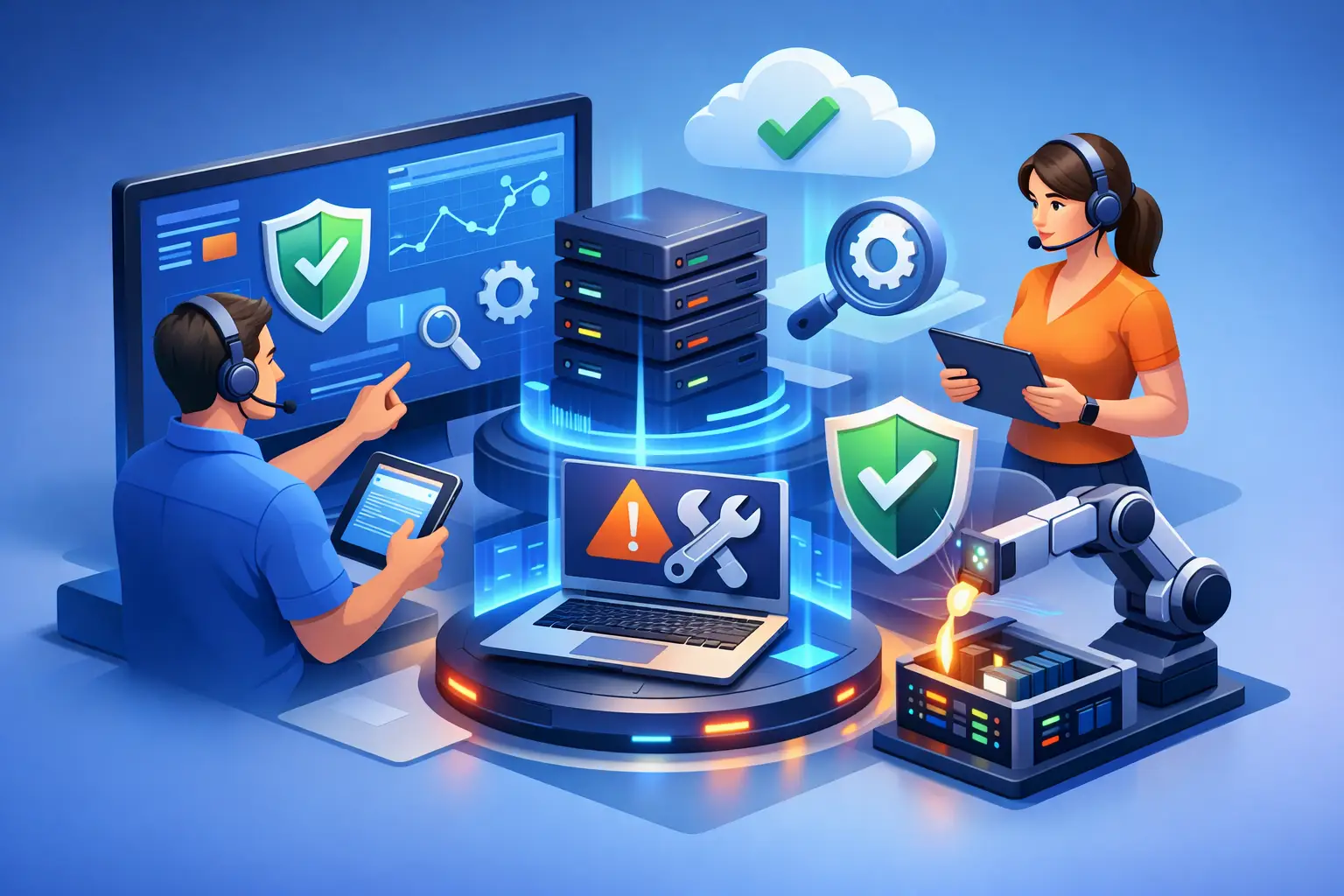
Why Proactive IT Support Services Matter
A server alert at 2:00 a.m. should not be the first sign that something has been failing for weeks. For small and mid-sized businesses, that is the real value of proactive IT support services. They are designed to catch risks early, reduce downtime, and keep technology aligned with the way the business actually operates.
Reactive support waits for users to report a problem. Proactive support looks for the conditions that create problems in the first place. That difference affects more than ticket volume. It shapes uptime, cybersecurity exposure, compliance readiness, employee productivity, and how confidently leadership can make growth decisions.
What proactive IT support services actually include
At a practical level, proactive IT support services combine monitoring, maintenance, security oversight, and planning into an ongoing operating model. Instead of treating support as a series of isolated incidents, the provider manages the environment continuously.
That usually starts with 24/7 monitoring across endpoints, servers, networks, cloud platforms, backups, and Microsoft 365 environments. If a device is running out of storage, a critical service stops unexpectedly, a backup fails, or suspicious activity appears after hours, the issue can be investigated before users walk into a broken system the next morning.
It also includes routine patch management, software updates, hardware lifecycle tracking, backup verification, identity and access controls, and documentation. In stronger service models, cybersecurity is not bolted on as a separate conversation. It is built into support through endpoint protection, threat detection, vulnerability management, MFA enforcement, logging, and incident response procedures.
The strategic layer matters too. Businesses do not just need technicians who can fix a printer queue or restart a server. They need guidance on budgeting, cloud adoption, vendor sprawl, compliance risk, and infrastructure decisions. That is where a managed IT partner begins to look less like a help desk and more like operational leadership.
Why reactive support gets expensive fast
Break-fix support can seem cost-effective when a company is small or has a relatively quiet environment. If issues feel occasional, paying only when something breaks may look efficient on paper. The trade-off is that costs become unpredictable, and the biggest losses rarely show up on the IT invoice.
A failed firewall, expired certificate, missed patch, or corrupted backup can interrupt billing, customer service, production, or remote access. The direct repair cost is one piece of the problem. Lost employee hours, delayed projects, reputational damage, and emergency recovery work usually cost more.
Reactive support also creates blind spots. If no one is reviewing logs, testing backups, tracking warranties, managing user permissions, or watching for unusual sign-in behavior, risk accumulates quietly. Many businesses discover this only after a ransomware event, audit issue, or prolonged outage forces a deeper look.
There is also a leadership cost. Executives and operations teams should not have to wonder whether systems are being maintained properly, whether security controls are current, or whether the company could recover from a serious incident. Uncertainty slows decisions.
The business case for proactive IT support services
The strongest argument for proactive support is not technical. It is operational.
When systems are monitored consistently and maintained on schedule, employees spend less time waiting on fixes and more time doing billable, customer-facing, or revenue-generating work. That matters for professional firms, healthcare offices, manufacturers, and any business where interruptions create immediate drag on service delivery.
Security improves because the environment is being watched, not ignored between incidents. Threats do not always arrive as dramatic events. They often begin with weak passwords, stale accounts, missing updates, open ports, or unusual login patterns. A proactive model reduces the chance that these warning signs go unnoticed.
Financial planning improves as well. Managed services replace irregular emergency costs with a more predictable structure. That does not mean every company needs the same level of coverage. A firm with internal IT may need co-managed support and 24/7 security monitoring, while another may need a fully outsourced model. The point is that support becomes intentional instead of improvised.
For regulated businesses, the compliance value is significant. Industries such as healthcare, legal, and financial services often need stronger documentation, access controls, backup procedures, and security policies than informal support arrangements can provide. Proactive service makes it easier to show that systems are being managed with discipline rather than good intentions.
Where proactive support delivers the biggest gains
The most visible gain is reduced downtime, but that is only part of the picture. Businesses often see the biggest improvement in areas that were quietly underperforming.
User onboarding and offboarding become cleaner. Devices are standardized. License management improves. Backup alerts get reviewed instead of ignored. Security controls become consistent across locations and remote staff. Network issues are diagnosed with actual performance data rather than guesswork.
This is especially important for growing companies. Growth tends to expose weak IT habits quickly. More employees, more devices, more cloud apps, more vendors, and more compliance pressure all create complexity. Without a proactive operating model, internal teams end up spending their time reacting to noise instead of building stable systems.
For businesses in the Dallas-Fort Worth area and other fast-growing markets, this often shows up during expansion, office moves, mergers, or hiring surges. Technology that was manageable at 20 users becomes risky at 60. Processes that lived in one person’s head stop working when the environment becomes more distributed.
What to look for in a provider
Not every managed service provider delivers truly proactive support. Some advertise the term but still operate mostly as a ticket desk with remote access tools.
A stronger provider will show you how monitoring works, what gets reviewed, how patching is handled, how backups are tested, and how security events are escalated. They should be able to explain their standards in business terms, not just technical jargon. If they cannot clearly describe how they reduce risk before incidents happen, the service may be more reactive than it appears.
Security integration is another dividing line. IT support and cybersecurity should not be treated as separate silos. If your support partner is not thinking about endpoint protection, identity management, vulnerability exposure, email security, and response planning, then part of your environment is being managed without enough context.
Documentation and accountability matter just as much. You should know who owns vendor coordination, what the escalation path looks like, what reporting is provided, and how strategic recommendations are delivered. A mature partner does not just fix symptoms. They create visibility.
It depends on your internal team
Proactive support is not one-size-fits-all. A company with a capable internal IT manager may not need full outsourcing. What they may need is co-managed support that fills operational gaps such as after-hours coverage, advanced security operations, cloud administration, or project execution.
On the other hand, a smaller business with no internal IT leadership may need a provider that can handle both daily support and higher-level planning. That includes budgeting, policy guidance, technology roadmaps, lifecycle planning, and business continuity strategy.
The right model depends on business complexity, regulatory pressure, growth stage, and leadership expectations. What matters is that someone is actively responsible for keeping the environment healthy, secure, and aligned with business goals.
Why this matters more now
The old line between IT support and business risk is gone. A support issue can become a security issue. A security issue can become a compliance problem. A compliance problem can become a customer trust problem.
That is why businesses are moving away from vendors who simply respond to tickets and toward partners who provide continuous oversight. Proactive IT support services create a more stable foundation for operations, but they also support better decision-making. Leaders can plan with more confidence when they know systems are maintained, risks are monitored, and someone is accountable for the bigger picture.
Sigma Networks works with businesses that need that level of oversight because technology support is no longer just about fixing what breaks. It is about protecting continuity, supporting growth, and reducing the number of avoidable surprises.
If your current support model only shows up after users are already impacted, that is not a small service gap. It is a sign that the business is carrying more risk than it should, and usually paying for it in ways that are harder to measure until the wrong day makes them obvious.
