

SOC Versus Internal Security Team: Which Fits?
A ransomware alert at 2:13 a.m. does not wait for the IT manager to return from vacation. That is the practical issue behind the SOC versus internal security team decision. Business leaders are not simply choosing who receives alerts. They are deciding how consistently the company can detect threats, contain incidents, protect sensitive data, and document its security posture when the stakes are high.
For small and mid-sized businesses, the answer is rarely as simple as outsourcing everything or hiring more people. The right model depends on your risk, regulatory obligations, existing IT capability, budget, and tolerance for business disruption.
SOC Versus Internal Security Team: The Core Difference
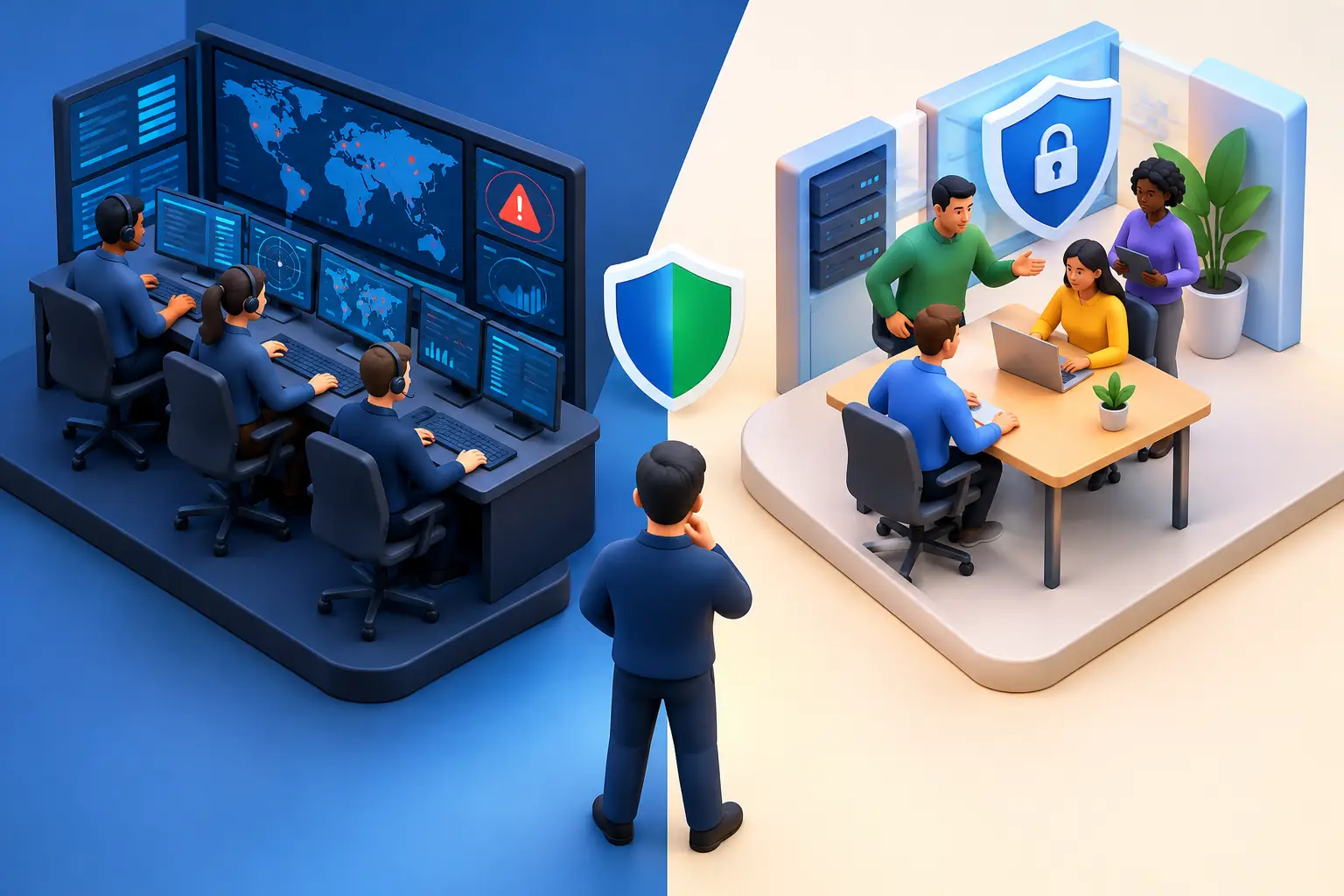
A security operations center, or SOC, is a dedicated function for continuously monitoring, investigating, and responding to cybersecurity events. A managed SOC is typically provided by an MSSP and supported by security analysts, threat intelligence, monitoring tools, documented response processes, and around-the-clock coverage.
An internal security team is made up of employees who work directly for your organization. Depending on company size, that could mean a security manager, a systems administrator with security responsibilities, an IT director, or a larger team with specialized roles in engineering, governance, compliance, and incident response.
The key distinction is not just who employs the people. It is the operating model. A SOC is built to maintain continuous visibility and incident response at scale. An internal team is often better positioned to understand the business context behind a system, user, vendor, or operational exception.
A well-run security program needs both capabilities. The real question is whether your organization can build and sustain them internally, or whether a managed security partner should provide the monitoring and response layer.
What an Internal Security Team Does Well
Internal teams bring institutional knowledge that is hard to replicate quickly. They understand which applications are business-critical, which employees need elevated access, how a manufacturing line or legal case-management system operates, and when an unusual login may actually be legitimate.
That context improves decision-making. An internal security leader can align security investments with business plans, help executives prioritize risk, and work directly with departments that may resist operational changes. They can also own policy development, vendor reviews, user training, asset lifecycle planning, and compliance coordination.
For organizations with complex environments, significant proprietary systems, or strict regulatory requirements, internal leadership is especially valuable. Healthcare groups, financial firms, engineering companies, and multi-location businesses often need someone accountable for security decisions within the organization.
However, internal ownership does not automatically create 24/7 protection. A skilled IT manager may be excellent at infrastructure, projects, and user support while still lacking the time, tooling, or specialized analyst coverage needed to investigate security events at all hours. Assigning security to an already busy IT generalist can create a dangerous gap between policy and real-world response.
Where a Managed SOC Adds Value
A managed SOC provides depth that is difficult for most mid-sized organizations to assemble internally. It can monitor endpoint, network, cloud, email, identity, and log data continuously, then triage suspicious activity using a defined process. When an event is confirmed, analysts can escalate it, recommend containment, and in many service models take approved response actions.
This matters because attackers do not work business hours. Credential misuse, malicious inbox rules, impossible travel alerts, and ransomware behaviors can emerge overnight, on weekends, or during periods when internal IT is focused on a major project.
A SOC also brings repeatable operational discipline. Analysts work from playbooks, correlate indicators across multiple systems, and have access to threat intelligence that helps distinguish ordinary noise from activity requiring immediate attention. That can reduce alert fatigue for internal staff and shorten the time between detection and action.
For businesses that need stronger security without building an enterprise-scale department, a managed SOC can provide a predictable monthly operating model. It is often more practical than hiring enough people to staff a round-the-clock operation, especially when recruiting and retaining experienced security professionals is difficult.
Still, a SOC is not a substitute for basic IT hygiene or leadership. Monitoring cannot compensate for unmanaged devices, weak identity controls, missing backups, undocumented systems, or a lack of executive decisions about acceptable risk.
Cost Is More Than Salary Versus Subscription
Many organizations begin the SOC versus internal security team comparison with price. That is reasonable, but the comparison needs to be complete.
The cost of an internal team includes salary, benefits, recruiting, training, certifications, management time, coverage for absences, security platforms, log storage, and incident-response readiness. One security hire can improve your posture, but one person cannot provide continuous coverage, specialized analysis, and reliable redundancy.
A managed SOC turns much of that operational expense into a defined service cost. Yet not all services provide the same value. Some vendors primarily forward alerts. Others investigate, prioritize, and assist with response. Decision-makers should understand what is monitored, who validates alerts, how fast critical events are escalated, and whether the provider can take containment actions when authorized.
The most meaningful financial comparison includes the cost of an incident. A few hours of downtime, a compromised email account, a missed compliance obligation, or a failed recovery can cost far more than the monthly difference between security models.
Control, Accountability, and Response Authority
Business leaders sometimes worry that outsourcing security means giving up control. In a properly structured relationship, it should mean gaining clearer accountability.
Your organization should retain ownership of its systems, data, risk decisions, and security policies. The provider should operate within agreed response procedures, maintain documentation, report on security activity, and escalate decisions that require business judgment. For example, a managed SOC may isolate a suspected infected device under a preapproved process, while a business leader decides whether to shut down a revenue-critical application during a broader incident.
Clear response authority matters before an incident occurs. If a suspicious login is detected, who can disable the account? If an endpoint shows ransomware behavior, who can isolate it? If a vendor system is involved, who contacts the vendor? Ambiguity adds minutes when minutes matter.
An internal team may have faster access to stakeholders and stronger authority over business systems. A managed SOC may have faster threat validation and wider security coverage. The strongest programs define how those strengths work together rather than forcing an either-or decision.
The Hybrid Model Is Often the Best Fit
For many growing companies, the practical answer is co-managed security. Internal IT or technology leadership owns the business relationship, strategic priorities, system knowledge, and day-to-day coordination. A managed security partner supplies 24/7 monitoring, managed detection and response, security expertise, and incident support.
This model avoids a common failure point: expecting a small internal team to be both strategic and continuously reactive. Your internal people can focus on improving infrastructure, supporting users, completing projects, and guiding the business. The SOC watches for threats and helps ensure a serious event does not sit unnoticed in a queue.
It also creates a better path for maturity. A company can begin with managed endpoint protection, identity security, email protection, backup oversight, and monitoring. As its needs evolve, it can formalize incident-response plans, compliance reporting, risk assessments, tabletop exercises, and executive technology planning.
How to Choose the Right Model
Start with your exposure, not a preferred service label. A professional services firm that stores client financial information has different requirements than a small office with limited systems. A healthcare organization subject to HIPAA, a manufacturer with operational technology, or a law firm managing confidential records may need higher levels of monitoring, documentation, and response preparedness.
Next, assess what your internal team can reliably do today. Can someone review critical alerts after hours? Is there a current inventory of devices and privileged accounts? Are backups tested? Does the business have a documented incident-response plan? Can leadership produce security evidence for a client, insurer, or auditor without a scramble?
If the answer to several of those questions is no, a managed SOC can close meaningful gaps quickly. If you already have mature security leadership and a capable internal team, external SOC coverage can still add scale, specialized tools, and off-hours protection.
Security operations are not a badge of independence. They are a business continuity function. Choose the model that gives your organization clear ownership, dependable response, and the confidence to keep operating when a threat becomes real.
