

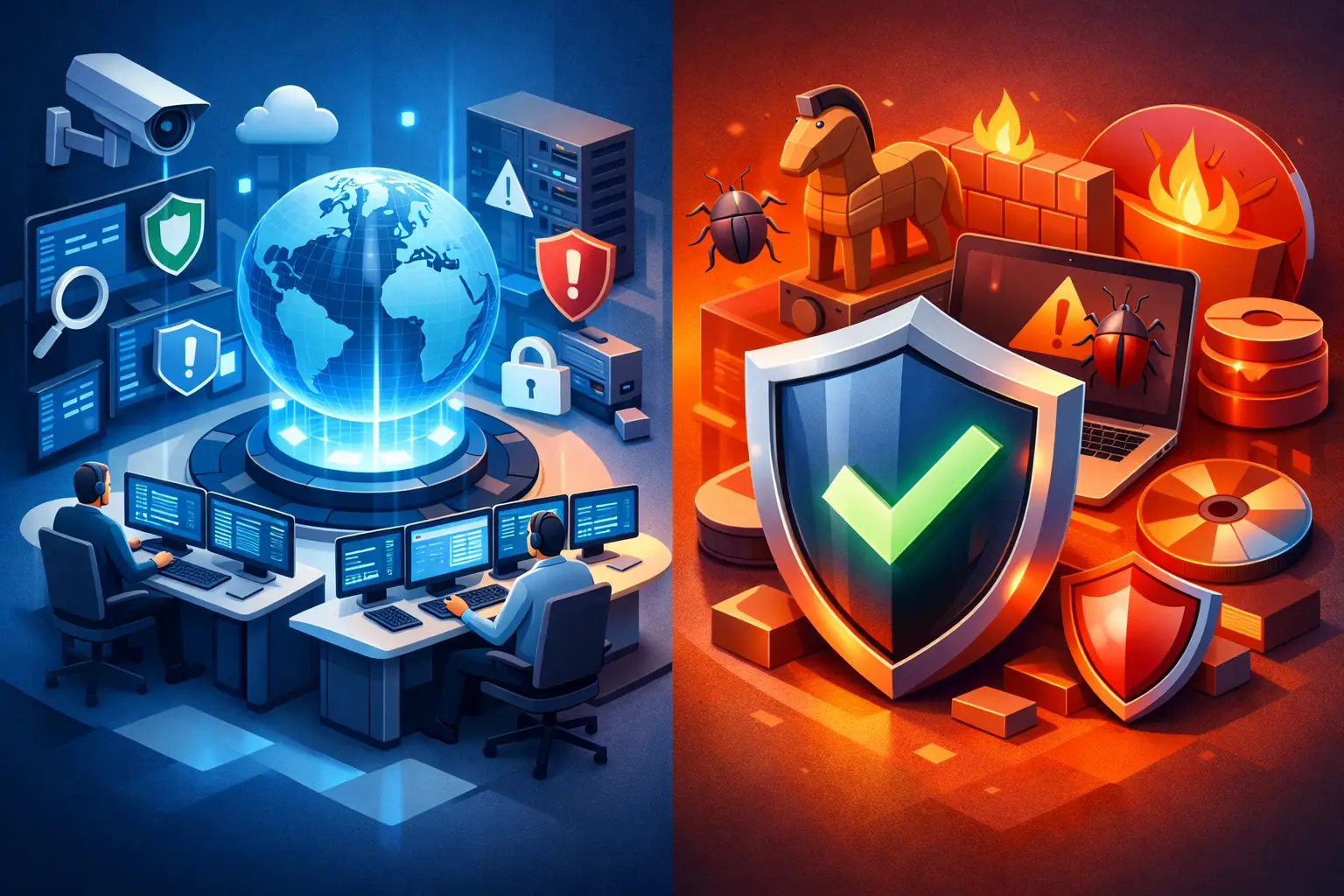
SOC Monitoring vs Antivirus: What Businesses Need
A single suspicious Microsoft 365 login at 2:13 a.m. may not look urgent on its own. Add an unfamiliar device, a mailbox rule forwarding invoices, and a connection to a known malicious domain, and the situation changes fast. This is the practical difference in the SOC monitoring vs antivirus conversation: antivirus can block a known bad file, while a security operations center can identify the pattern, investigate it, and take action before it becomes a business interruption.
For small and mid-sized businesses, this is not a choice between an old tool and a newer service. Antivirus remains a necessary endpoint control. SOC monitoring adds the people, processes, and visibility needed to respond to threats that bypass or misuse those controls. Understanding where each fits helps business leaders invest in security that protects operations, client trust, and compliance obligations.
SOC Monitoring vs Antivirus: The Core Difference
Antivirus is software installed on endpoints such as laptops, workstations, and servers. Its primary job is prevention. It scans files, processes, and system behavior for malware and suspicious activity, then blocks, quarantines, or alerts on what it detects. Modern endpoint protection platforms may also use behavioral analysis and threat intelligence, making them much more capable than the signature-based antivirus products of the past.
A security operations center, or SOC, is a function rather than a single product. It continuously collects and analyzes security signals from across the environment: endpoints, firewalls, Microsoft 365, identity systems, cloud applications, servers, and network devices. Analysts review alerts, correlate related events, determine whether activity is malicious, and coordinate containment and remediation.
The distinction matters because many serious incidents do not begin with an obvious malware file. An attacker may use a stolen password, abuse a legitimate remote access tool, impersonate a vendor through email, or exploit a misconfigured cloud account. Antivirus may have little to block in these scenarios. SOC monitoring is designed to recognize abnormal behavior across multiple systems.
What Antivirus Does Well
Antivirus is still a foundational layer of business security. When properly deployed and centrally managed, it can stop common threats before they reach users or spread through the network. It is particularly effective at identifying known malware, suspicious downloads, ransomware behavior, malicious scripts, and unsafe applications.
For a business with limited IT resources, managed endpoint protection also provides valuable baseline control. Administrators can verify that devices are protected, investigate detections, enforce policies, and remove risky software. This is far more effective than relying on employees to keep individual antivirus subscriptions current.
However, antivirus has limits. It sees activity primarily through the endpoint where it is installed. It may generate alerts without the context to tell whether an isolated event is harmless, a false positive, or part of an active intrusion. It also cannot replace identity security, secure network configuration, email protection, patch management, backup, or a documented incident response process.
What SOC Monitoring Adds
SOC monitoring extends security beyond prevention into detection and response. The SOC looks at the environment as a connected system, rather than a series of individual devices. This broader view is especially valuable when threats move between email, identities, cloud services, endpoints, and networks.
Consider a compromised employee account. A criminal may sign in from an unusual location, create a mailbox forwarding rule, access shared files, and attempt to log in to a financial application. No malware may be involved. A SOC can correlate these events, validate the risk, disable the session or account when appropriate, and notify the right people with a clear explanation of what happened.
A mature SOC function typically provides 24/7 alert monitoring, threat investigation, event correlation, escalation, containment guidance, and incident documentation. Depending on the service model and client environment, it may also support direct response actions such as isolating a device, blocking indicators, or resetting credentials. The objective is not simply to generate more alerts. It is to reduce the time between threat activity and a decisive response.
That response capability is critical for organizations that cannot staff a round-the-clock internal security team. A business may have an internal IT manager who knows the environment well but cannot reasonably monitor security events every night, weekend, and holiday. Co-managed SOC services give that team additional coverage without requiring enterprise-scale headcount.
Why Antivirus Alerts Alone Can Create Risk
An antivirus console can produce useful alerts, but alerts do not equal security outcomes. Someone must review them promptly, understand their severity, and determine what action is required. If alerts sit unattended until the next business day, an attacker may have hours to steal data, encrypt systems, or establish persistent access.
Alert fatigue is another concern. Security tools can flag thousands of events, many of which are low risk or benign. Internal teams often have competing responsibilities: supporting employees, managing vendors, maintaining systems, and completing strategic projects. Without a disciplined triage process, high-priority activity can get lost in the volume.
SOC analysts use context to separate routine noise from meaningful risk. They examine the user, device, login history, threat intelligence, network activity, and related events. This is where security monitoring becomes an operational service rather than a dashboard that someone hopes to check regularly.
Which Approach Is Right for Your Business?
The right answer is usually both, but the depth of coverage should match your risk profile. Every organization should have centrally managed endpoint protection, supported operating systems, patching, secure identity controls, and reliable backups. These are baseline measures, not optional upgrades.
SOC monitoring becomes increasingly necessary when your business handles regulated data, supports remote or hybrid staff, relies heavily on Microsoft 365 or cloud applications, processes payments, or cannot tolerate significant downtime. Healthcare practices, law firms, financial services firms, manufacturers, engineering organizations, and professional service businesses often face elevated exposure because they hold sensitive information and depend on continuous access to systems.
A smaller firm with a simple environment may begin with managed endpoint detection and response combined with targeted monitoring. A growing organization with multiple locations, remote workers, compliance requirements, or an internal IT team may benefit from a broader managed detection and response program with 24/7 SOC coverage. The decision should be based on business impact, not fear-driven tool shopping.
Ask practical questions: Who investigates a critical alert at 3:00 a.m.? How quickly can suspicious access be contained? Are Microsoft 365, firewalls, endpoints, and backups monitored together? Can your provider document investigation and response activity for audits, insurance, or client requirements? Clear answers reveal whether your current security program is equipped for a real incident.
Security Coverage Must Connect to Business Continuity
Security tools work best when they are managed as part of a broader operating model. Endpoint protection should connect with patch management, privileged-access controls, email security, secure networking, immutable backups, disaster recovery planning, and employee awareness training. SOC monitoring adds oversight to that ecosystem by identifying when controls fail, users make mistakes, or attackers find another path.
This connection also improves accountability. When an incident occurs, leadership needs more than a technical alert. They need to know what systems were affected, what data may be at risk, what containment steps were taken, whether operations can continue, and what should change afterward. A strategic managed IT and cybersecurity partner helps translate security activity into decisions the business can act on.
For organizations in DFW and beyond, the strongest security posture is not built around a single product label. It comes from layered controls, continuous oversight, and a team that treats every alert in the context of your operations.
Antivirus should stop what it can. SOC monitoring should watch for what gets through, what behaves abnormally, and what threatens the business after hours. Start by identifying who owns that responsibility in your organization, then make sure they have the visibility and authority to act when it matters.
