

Outsourced IT Versus Internal Hiring: What Fits?
A server fails at 7:15 a.m. A phishing email reaches several employees before the workday begins. Microsoft 365 permissions need attention before a new hire starts. For a growing business, these are not isolated IT tickets. They are operational and security decisions that affect revenue, trust, and productivity.
That is why the choice between outsourced IT versus internal hiring deserves more than a quick comparison of salary and monthly service fees. The right model must give your organization dependable support, accountable security oversight, and a technology plan that can keep pace with the business.
Outsourced IT Versus Internal Hiring: Start With the Work
Internal hiring can be the right investment when technology is central to how your company delivers its product or service, when your environment is highly specialized, or when you need someone embedded in daily operations. An experienced internal IT leader can understand company history, workflows, personalities, and priorities at a granular level.
But one person is rarely a complete IT department. Modern IT requires help desk coverage, endpoint management, network administration, cloud expertise, backup oversight, vendor coordination, cybersecurity monitoring, compliance documentation, and strategic planning. Expecting one hire to cover all of that well creates a familiar risk: the urgent requests get handled while preventive work quietly falls behind.
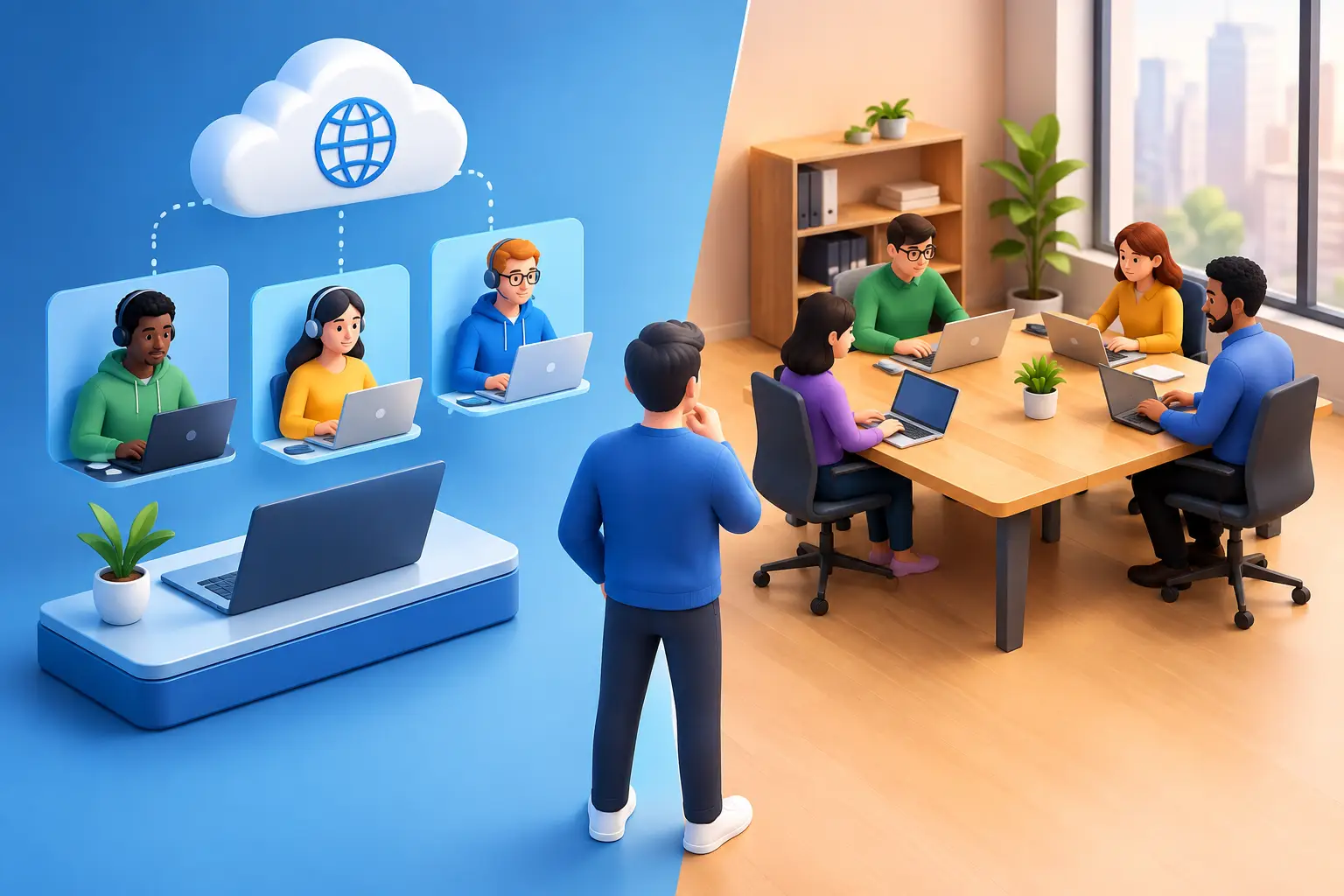
Outsourced IT changes the model. Instead of hiring for a single set of skills, you gain access to a team with defined processes, specialized roles, tools, and coverage. A managed service provider can monitor systems, standardize devices, resolve user issues, manage cloud platforms, and maintain documentation. An MSSP adds a security-focused layer that supports detection, response, and ongoing risk reduction.
The question is not whether internal staff or an outsourced provider is inherently better. It is whether your chosen model can reliably perform the work your business needs before an incident forces the issue.
Compare the Full Cost, Not Just the Salary
An internal IT salary is only the visible portion of the investment. Recruiting, benefits, payroll taxes, training, certifications, software tools, security platforms, after-hours coverage, and turnover all add to the real cost. If an IT manager leaves, the organization may also lose institutional knowledge, administrative access, and momentum on important projects.
Outsourced IT typically replaces unpredictable break-fix spending with a recurring monthly investment. For many small and mid-sized businesses, that makes budgeting easier and gives leadership a clearer view of what is included. The value is not simply lower cost. It is the ability to access broader capabilities without building each capability internally.
Still, price alone should not determine the decision. A low-cost provider that only responds after something breaks may leave major gaps in security, documentation, backup testing, and long-term planning. Likewise, an internal hire who is overloaded and lacks the right tools can become an expensive single point of failure.
A useful comparison asks: What would it cost to provide dependable support, security monitoring, business continuity planning, and strategic guidance at the level our business requires? That number is more meaningful than comparing a monthly managed services quote against one employee’s base salary.
Security Coverage Is a Deciding Factor
Cybersecurity has made the internal-versus-outsourced decision more complex. Attackers do not limit activity to business hours, and most organizations cannot depend on a single IT professional to continuously monitor alerts, investigate suspicious behavior, patch systems, train employees, and coordinate incident response.
An internal team may have strong knowledge of the business, but it needs enough capacity and security depth to act on that knowledge. In regulated industries such as healthcare, legal, finance, and manufacturing, the stakes include more than downtime. A security failure can trigger contractual problems, lost client confidence, reporting obligations, and compliance exposure.
A mature outsourced IT and security partner should bring more than antivirus software. Look for clear ownership of endpoint protection, identity and access controls, email security, vulnerability management, backup verification, incident response procedures, and security reporting. The provider should be able to explain what is being monitored, who responds after hours, and how risk is communicated to leadership.
Security is also where accountability matters most. If a provider is responsible for a service, the scope, response expectations, and escalation path should be documented. If responsibilities remain internal, leadership should know who owns each control and whether that person has the time and authority to maintain it.
Control Does Not Have to Mean Doing Everything In-House
Some leaders hesitate to outsource because they do not want to lose control of their technology. That concern is reasonable, especially when systems hold client data, financial records, intellectual property, or regulated information.
The right partner does not take control away from the business. It creates better control through documentation, standards, reporting, and a defined decision-making process. Your company should retain ownership of its accounts, data, network configuration, and key vendor relationships. You should also have visibility into open risks, support trends, technology spending, and planned improvements.
A good outsourced relationship is not a black box. It is a working operating model. Leadership sets the business priorities. The provider translates those priorities into practical technology decisions, maintains the environment, and brings concerns forward before they become expensive emergencies.
For companies with an existing IT manager or technician, co-managed IT can be the strongest option. Internal staff remain close to users and business operations while the outsourced team fills gaps in cybersecurity, monitoring, project delivery, escalation support, and 24/7 coverage. This approach protects internal talent from being consumed by repetitive support work while giving the business more depth.
When Internal Hiring Makes Sense
Building internal IT capabilities can be a smart choice when your organization has enough scale to support a team rather than a lone generalist. It also makes sense when you operate proprietary systems, require constant onsite technical work, or have technology needs that are unusually specialized.
Even then, internal hiring should be paired with a realistic coverage plan. Who handles major incidents when the IT director is on vacation? Who monitors security events overnight? Who has the skills to manage cloud architecture, compliance evidence, or a disaster recovery event? A strong internal department often still uses outside specialists for security operations, major projects, and advanced engineering support.
Internal hiring works best when it is treated as a capability-building strategy, not simply a way to avoid a managed services contract. The business must be prepared to invest in the people, tools, processes, and leadership required to make that strategy sustainable.
When Outsourced IT Is the Better Fit
Outsourced IT is often a practical fit for organizations that need enterprise-level discipline without the cost and complexity of a full internal department. This includes firms with 20 to 300 employees, multiple offices, compliance requirements, remote or hybrid teams, or limited tolerance for downtime.
It is particularly valuable when technology has grown faster than internal oversight. Common signs include inconsistent onboarding and offboarding, undocumented systems, recurring network issues, backups that have not been tested, slow user support, unmanaged devices, or executives who are making technology decisions without a clear roadmap.
For DFW businesses facing growth, acquisitions, office moves, or increased security requirements, a provider such as Sigma Networks can supply the operational structure that is difficult to assemble quickly in-house. The goal is not to outsource responsibility. It is to gain an accountable technology partner with the capacity to protect the business and support its next stage.
Make the Decision Based on Risk and Growth
Before choosing a model, assess the business consequences of a failed system, ransomware event, missed compliance requirement, or prolonged support backlog. Then assess whether your current team, prospective hire, or outsourced partner has the coverage and authority to reduce those risks.
Ask practical questions. Do we need 24/7 security visibility? Are our backups recoverable, not merely running? Can we support new locations or employees without adding operational friction? Do leaders receive clear guidance on technology investments? The answers will usually point toward internal hiring, outsourced support, or a co-managed structure.
The strongest IT decision is the one that gives your people reliable help, gives leadership clear accountability, and gives your business room to grow without carrying unmanaged risk. Secure IT is not a staffing label. It is an operating commitment that should hold up on an ordinary workday and during the incident you hope never happens.
