

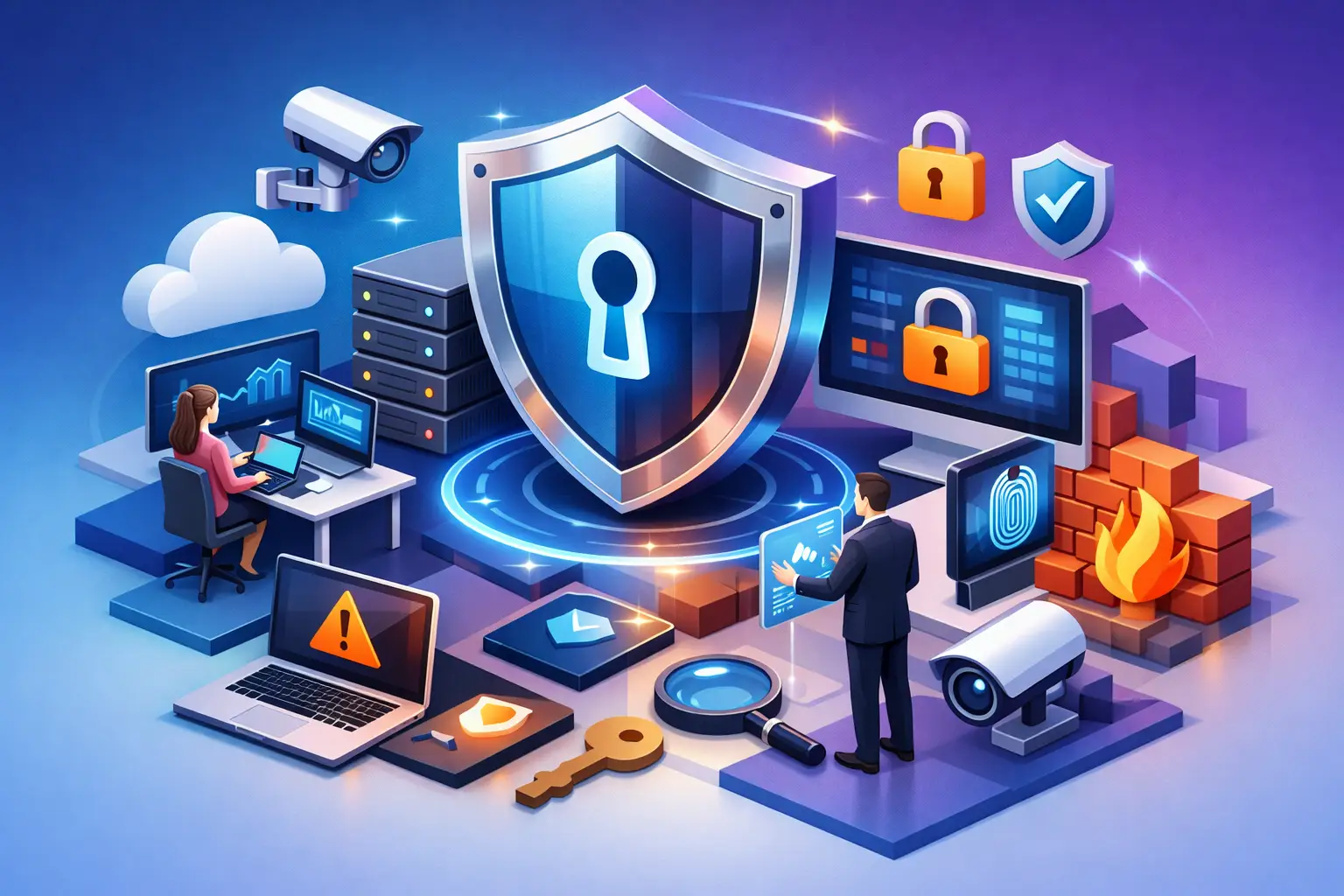
Managed Security Services Guide for SMBs
A ransomware alert at 2:13 a.m. does not care whether your business has a full internal IT team, one overextended administrator, or no dedicated security staff at all. That is exactly why a managed security services guide matters for small and mid-sized businesses. The real question is not whether threats are increasing. It is whether your business has the people, processes, and coverage to detect, respond, and recover before an incident becomes downtime, legal exposure, or a client trust problem.
What managed security services actually mean
Managed security services are outsourced cybersecurity functions delivered by a specialized provider. That can include 24/7 monitoring, threat detection, incident response, endpoint protection, firewall management, email security, vulnerability management, compliance support, and reporting.
For many SMBs, the appeal is practical. Building an in-house security operation is expensive, difficult to staff, and hard to sustain around the clock. A managed security provider gives you access to trained analysts, established tools, and documented processes without requiring you to build a security operations center from scratch.
That said, not every provider delivers the same level of protection. Some focus narrowly on tool management. Others act more like a strategic partner, aligning security controls with business continuity, compliance, cloud operations, and overall IT management. That difference matters.
Who needs a managed security services guide most
If your company handles regulated data, relies heavily on cloud applications, supports hybrid work, or cannot tolerate prolonged downtime, security is no longer a side function. Healthcare practices, law firms, manufacturers, financial services firms, architecture and engineering companies, and professional service organizations are common examples. They tend to share the same challenge: real risk, limited internal bandwidth, and increasing pressure to document controls.
A growing company can also outgrow basic antivirus and occasional IT checkups faster than leadership expects. Once your environment includes Microsoft 365, remote access, shared file platforms, VoIP, line-of-business applications, and vendor integrations, your attack surface expands. Security has to keep pace with growth.
Core services to expect from a managed security provider
A useful managed security services guide should separate essential services from optional extras. At a minimum, most businesses should expect continuous monitoring, alert triage, endpoint protection, firewall oversight, email security, and escalation procedures when suspicious activity appears.
24/7 monitoring and threat detection
Security events do not happen on a business-hours schedule. Around-the-clock monitoring is one of the clearest reasons companies work with an MSSP. The goal is not simply to collect alerts. It is to review them, reduce false positives, and identify credible threats early enough to act.
Managed detection and response
Managed detection and response, often called MDR, goes beyond basic alerting. It combines endpoint telemetry, investigation, threat hunting, and guided response. For SMBs, MDR is often more valuable than a stack of disconnected security tools because it turns technical signals into action.
Firewall, network, and access security
Your perimeter may not look like a traditional perimeter anymore, but network security still matters. A provider should be able to manage firewalls, review configurations, monitor suspicious traffic, support VPN or secure remote access, and help enforce least-privilege access.
Email and identity protection
Many attacks still start with phishing, credential theft, or account compromise. Strong managed security services should address inbox threats, suspicious sign-ins, multi-factor authentication, and conditional access controls. If your business runs on Microsoft 365, this area deserves special attention.
Vulnerability management and patch oversight
Security tools cannot compensate for unpatched systems and outdated software. Providers should identify vulnerabilities, prioritize them based on risk, and coordinate remediation. In some environments, especially those with legacy applications or operational constraints, remediation timing depends on business impact. A good provider helps you balance urgency with operational reality.
Incident response and recovery support
Detection without response is not enough. Ask what happens when a confirmed threat is found. Will the provider isolate devices, disable accounts, preserve logs, guide internal stakeholders, and support recovery? Clear playbooks, communication paths, and responsibilities matter as much as technology.
What this managed security services guide says to evaluate first
The right provider is not just the one with the longest tool list. It is the one that can protect your environment in a way that fits your business.
Start with coverage. Do you need fully managed security, or do you have internal IT that needs co-managed support? A business with an in-house IT manager may need escalation help, after-hours monitoring, and compliance reporting. A smaller office may need one partner to handle both day-to-day IT and cybersecurity under a single operating model.
Next, look at operational maturity. Ask how alerts are triaged, how incidents are documented, who responds after hours, and what reporting leadership receives. If the answers are vague, the service may be more reactive than proactive.
Then consider business alignment. Security should support uptime, insurability, audit readiness, and growth. If a provider talks only about software features and not about risk reduction, recovery planning, or executive visibility, that is a warning sign.
Pricing depends on more than seat count
Many SMBs want a simple number, but security pricing usually depends on users, devices, locations, cloud platforms, regulatory requirements, and how much response work is included. A basic monitoring package may look affordable, but if it excludes incident handling, strategic reviews, or compliance support, the real cost can show up later.
The lowest monthly price is rarely the lowest business risk. On the other hand, buying an enterprise-grade package your company will not use is not efficient either. The best fit is a service model that matches your threat profile, internal capacity, and operational dependence on technology.
Common gaps businesses discover too late
A lot of companies assume they are covered because they have antivirus, a firewall, and cyber insurance. That assumption breaks down quickly during an incident. Insurance carriers increasingly require stronger controls. Basic tools may generate alerts no one reviews. Internal teams may not have the time to investigate suspicious behavior in real time.
Another common gap is separation between IT and security. If one vendor manages infrastructure and another manages security, accountability can get blurry when something goes wrong. For many SMBs, there is real value in working with a partner that can connect endpoint security, cloud administration, backup, recovery, network policy, and executive planning into one strategy.
Questions to ask before you sign
Ask how the provider handles after-hours incidents and whether response actions are included or billed separately. Ask what they monitor across endpoints, cloud systems, email, and network infrastructure. Ask how often they review policies, vulnerabilities, and access controls.
You should also ask about reporting. Leadership needs more than raw logs. Good reporting should show trends, risks, actions taken, and where the environment still needs improvement. For regulated organizations, documentation can be just as important as detection.
Finally, ask who owns the relationship. A mature provider gives you both technical coverage and strategic oversight. That may include recurring reviews, roadmap planning, and guidance tied to compliance, insurance requirements, and business growth.
When managed security works best
Managed security services work best when they are part of a broader operating model, not a bolt-on purchase. Security improves when endpoint controls, identity management, backup, employee training, cloud administration, and IT governance support each other.
That is why many businesses choose a partner that can function as both MSP and MSSP. It reduces handoffs, improves accountability, and makes it easier to align security decisions with daily operations. For a growing company in DFW or anywhere else with limited internal resources, that integrated approach often delivers more practical value than a set of disconnected security subscriptions.
A strong provider should make your business more resilient, not more dependent on guesswork. If your current setup leaves questions about who is watching, who responds, and how risk is being reduced over time, it may be time to treat security as a managed business function rather than an occasional IT task. Secure IT. Smarter Business.
