

Is Outsourced Cybersecurity Worth It for SMBs?
A compromised Microsoft 365 account, a ransomware event, or a failed compliance review can turn a normal business day into an expensive operational crisis. For leaders already balancing growth, staffing, client demands, and technology costs, the practical question is: is outsourced cybersecurity worth it?
For many small and mid-sized businesses, the answer is yes – but only when the provider delivers more than antivirus software and a help desk number. The value comes from continuous oversight, accountable response, and a security program that fits the way the business actually operates. Outsourcing is not a substitute for leadership or good internal practices. It is a way to gain capabilities that would be difficult and costly to build alone.
What outsourced cybersecurity should provide
Outsourced cybersecurity means relying on a specialized partner to manage some or all security responsibilities. The exact model varies. A business may outsource monitoring and incident response while retaining an internal IT manager, or it may engage a managed service provider to oversee endpoints, identity, cloud applications, backups, network security, user support, and strategic planning as one coordinated program.
The difference matters. A collection of security tools does not equal security operations. Someone must configure those tools correctly, review alerts, investigate suspicious activity, keep systems patched, document decisions, and respond when an incident occurs at 2:00 a.m. A quality managed security service turns technology into an operating discipline.
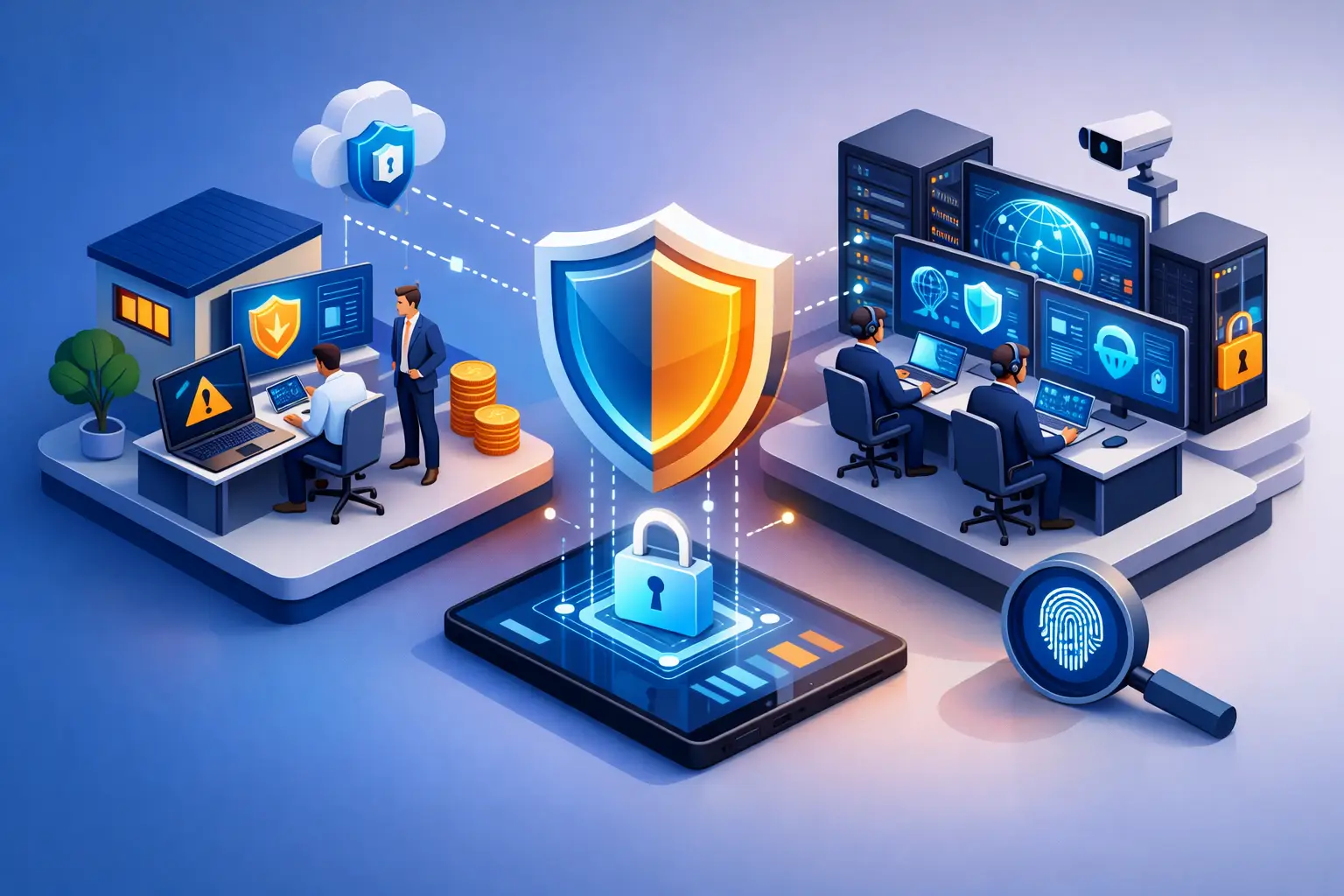
For a typical SMB, that can include 24/7 monitoring, managed detection and response, endpoint protection, email security, vulnerability management, secure Microsoft 365 administration, backup oversight, security awareness training, and incident-response planning. Regulated organizations may also need evidence and policies that support HIPAA, financial-services requirements, client security questionnaires, cyber insurance applications, or contractual obligations.
Is outsourced cybersecurity worth it compared with hiring in-house?
The comparison is not simply outsourced services versus one internal IT employee. Effective cybersecurity requires different skill sets: identity and cloud security, network security, endpoint management, threat detection, incident response, compliance, backup recovery, and strategic risk planning. Finding all of that expertise in one role is unlikely. Building a full internal team is beyond the budget of many businesses with 25 to 500 employees.
An internal IT professional remains highly valuable. They understand company workflows, users, applications, and business priorities. But if that person is also responsible for daily support, new-hire setup, vendor coordination, and infrastructure projects, security monitoring often becomes a task that gets deferred. Attackers do not wait for the IT calendar to clear.
Outsourcing gives a business access to a broader bench of expertise and established processes for a predictable monthly investment. It also reduces dependence on one individual. If the only person who understands your firewall rules, recovery procedures, or Microsoft 365 tenant leaves, the company should not be left exposed.
That said, outsourcing is not automatically less expensive in every situation. A larger organization with a mature security team, a dedicated security leader, and specialized internal requirements may need a co-managed model rather than full outsourcing. The best arrangement assigns responsibilities clearly instead of creating gaps between internal staff and an external provider.
The real cost is more than the monthly fee
Cybersecurity proposals are often evaluated as a line-item expense. That is understandable, but it is incomplete. The better question is what the business would pay if security controls fail.
Costs after an incident can include downtime, emergency technical work, lost revenue, legal counsel, notification obligations, forensics, recovery effort, regulatory scrutiny, higher cyber insurance costs, and damaged client trust. A manufacturer unable to access production systems, a law firm unable to reach case files, or a healthcare practice unable to use scheduling and records platforms may lose far more in a day than it saved by postponing security improvements.
There is also a quieter cost: unmanaged risk. Unpatched devices, weak multifactor authentication, former employees retaining access, incomplete backups, and untested recovery procedures may not create an immediate crisis. They create conditions in which a minor mistake becomes a major interruption.
A worthwhile outsourced security program helps reduce both the likelihood and the impact of these failures. It cannot promise that an attack will never happen. No responsible provider should make that claim. It should, however, improve prevention, detect threats earlier, contain incidents faster, and give leadership a documented plan for recovery.
Where outsourced security delivers the strongest value
Outsourcing tends to make the most business sense when an organization has meaningful risk but limited internal depth. That includes professional services firms handling confidential client data, healthcare organizations managing protected health information, financial organizations facing strict controls, and growing businesses that rely heavily on Microsoft 365, cloud applications, and remote access.
It is especially valuable when a company needs coverage beyond office hours. Many attacks begin with an account takeover or suspicious login that requires prompt investigation. A provider with 24/7 security operations can review and escalate activity when the internal team is unavailable.
Businesses also benefit when cybersecurity is connected to their broader IT environment. Email security works best when identity controls are properly managed. Backup is only useful when recovery is tested. Compliance readiness depends on documentation, access control, patching, and consistent processes. Treating each area as an isolated purchase can leave gaps that no one owns.
For DFW companies with lean internal teams, a strategic partner can also bring structure to fast growth. New offices, remote employees, acquisitions, and client compliance demands all change the risk profile. Security needs to scale with the business, not become an emergency project after something goes wrong.
What to expect from the right provider
The quality of the provider determines whether outsourcing becomes a business advantage or another vendor relationship to manage. Low-cost offerings sometimes focus on installing tools while leaving alert review, remediation, and strategic accountability unclear. That may create a false sense of protection.
Ask direct questions about who is watching, what happens after an alert, and how quickly meaningful incidents are escalated. Find out whether the provider performs regular security reviews, vulnerability remediation, backup recovery testing, and executive reporting. Ask whether they will help document controls for insurers, auditors, and customer questionnaires.
A strong partner should also explain responsibility boundaries in plain language. For example, the provider may manage endpoint detection, identity policies, patching, and security monitoring, while your organization owns employee behavior, approval of risk decisions, and timely reporting of suspicious activity. Clear ownership is essential during an incident.
Look for these signs of an accountable security relationship:
- Defined response and escalation procedures, including after-hours coverage
- Security tools that are actively managed, not merely installed
- Regular reporting that connects technical findings to business risk
- Documented backup, disaster recovery, and incident-response processes
- A roadmap that prioritizes improvements based on risk, budget, and growth plans
Sigma Networks approaches this work as a strategic technology partnership, combining managed IT, security operations, and advisory support so security decisions align with operational goals rather than becoming isolated technical projects.
When outsourcing may not be the right answer
Outsourced cybersecurity is not a cure for poor governance. If leadership will not enforce multifactor authentication, approve essential remediation, train employees, or maintain realistic technology budgets, even an excellent provider will have limited impact.
It can also be a poor fit when a business needs highly specialized, fully dedicated security personnel for proprietary environments or unusually complex regulatory obligations. In those cases, a co-managed approach often works better: internal staff retain close control while an external security team provides monitoring, tools, expertise, and coverage.
Finally, be cautious if the proposed service is vague. Terms such as managed security or protected endpoints mean little without specifics. Businesses should know which systems are covered, which threats are monitored, how response works, what reporting they receive, and what remains outside the agreement.
Make the decision around risk, not fear
The right decision is not driven by alarming headlines. It is driven by a clear view of what your business must protect, how long it can tolerate disruption, and whether current resources can meet that responsibility consistently.
Start by identifying your critical systems, sensitive data, compliance obligations, recovery objectives, and internal security capacity. Then evaluate whether an outside partner can provide measurable coverage, faster response, and stronger accountability than your current model. If the answer is yes, outsourced cybersecurity is not simply an IT expense. It is a practical investment in keeping the business operational, trusted, and prepared for what comes next.
