

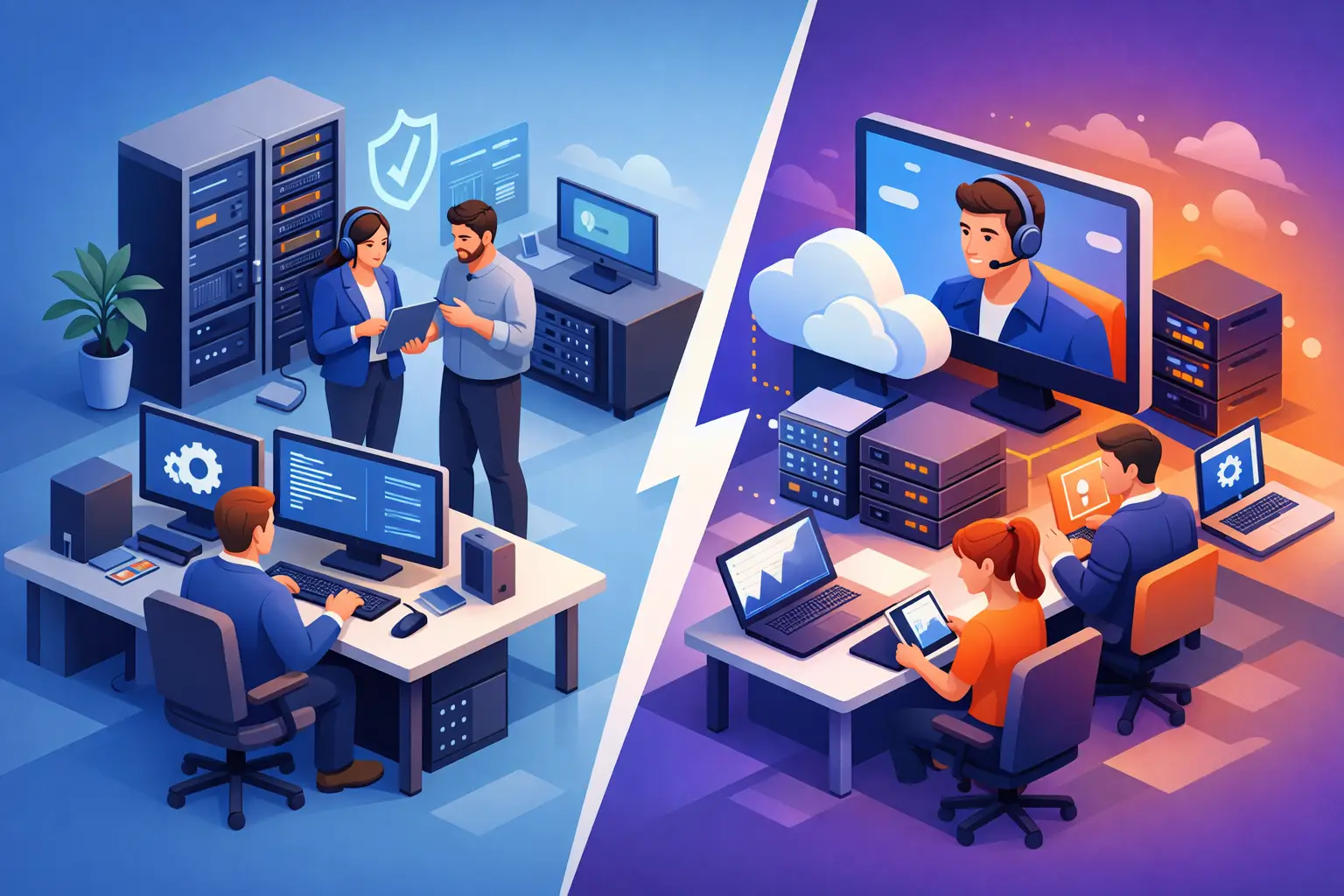
Internal IT vs Managed Services
A single failed backup, a stalled line-of-business app, or a phishing incident at 4:50 p.m. can expose the real difference between internal IT vs managed services. For small and mid-sized businesses, this is rarely a pure technology debate. It is an operating model decision that affects risk, staffing, budgeting, compliance, and how confidently the business can grow.
Some companies assume internal IT gives them more control. Others look at managed services as a way to lower cost. Both views are incomplete. The better question is which model gives your organization the right coverage, accountability, and strategic direction for the complexity you actually face.
Internal IT vs managed services: the real difference
Internal IT means your business hires employees to manage technology in-house. That may be one generalist, a small team, or a more specialized department. Managed services means you outsource some or all IT functions to a provider under an ongoing service agreement, often with defined response times, monitoring, security oversight, and strategic planning.
The distinction is not just where the work happens. It is how the work is structured. Internal IT depends on the skills, availability, and bandwidth of the people you can recruit and retain. Managed services gives you access to a broader bench of expertise, documented processes, and a service model built around continuity.
For many SMBs, the decision is not all or nothing. Co-managed IT is often the most practical middle ground. Your internal team keeps ownership of business-specific priorities while an outside partner handles monitoring, security operations, patching, backup oversight, escalations, and after-hours support.
Where internal IT is strong
Internal IT can be the right fit when your environment is highly specialized or tightly tied to daily operations. An in-house team usually understands your workflows, users, systems, and internal politics better than any outside provider can on day one. That context matters when technology directly supports production, customer service, or regulated business processes.
There is also value in physical presence. If your office, clinic, or facility needs frequent hands-on support, an internal technician can resolve certain issues faster simply by being there. For companies with custom applications, legacy infrastructure, or department-specific systems, that institutional knowledge can be hard to replace.
Internal teams also help when leadership wants close alignment between IT and business operations. A capable IT manager who understands budgets, vendor relationships, and security priorities can become a strong internal leader, not just a technical resource.
Still, those strengths depend heavily on who you hire. One excellent systems administrator can stabilize a lot. One overwhelmed generalist can become a single point of failure.
Where internal IT becomes risky
The biggest issue for SMBs is coverage. One or two internal hires may handle help desk tickets, vendor calls, Microsoft 365 administration, firewall issues, endpoint security, onboarding, offboarding, backups, and compliance requests. That is a wide scope for a small team, especially if the business expects strategic planning on top of daily support.
Security is usually where the gap becomes obvious. Modern cybersecurity requires more than antivirus and a firewall. It takes alert monitoring, vulnerability management, identity controls, incident response discipline, endpoint detection, backup validation, user security awareness, and consistent documentation. Most small internal teams do not lack commitment. They lack time and specialized depth.
Staffing is another challenge. Hiring experienced IT and cybersecurity talent is expensive, and retention is not easy. If your key IT employee resigns, goes on leave, or burns out, the business can lose critical knowledge overnight. That problem gets more serious in regulated industries where documentation, audit readiness, and change control matter.
Then there is the after-hours reality. Systems fail at inconvenient times. Threat activity does not follow business hours. If your business depends on one internal person checking alerts the next morning, your exposure is higher than it appears on paper.
Where managed services create business value
Managed services are most effective when the business needs consistent coverage, stronger security discipline, and predictable operations without building a full internal enterprise IT department. A mature provider brings structure that many SMBs struggle to create on their own.
That structure usually includes 24/7 monitoring, ticketing processes, patch management, backup oversight, documentation standards, vendor coordination, and defined escalation paths. Instead of relying on one person to know everything, you gain access to a team with different specialties across cloud, networking, security, compliance, and end-user support.
This model also improves cost visibility. Internal IT costs are often underestimated because salary is only one part of the equation. Recruiting, benefits, training, tools, security software, management overhead, and turnover all add up. Managed services turns much of that into a predictable operating expense with clearer deliverables.
For leadership teams, the strategic value can be just as important as day-to-day support. A good managed partner should not simply close tickets. It should help plan lifecycle upgrades, reduce avoidable risk, support compliance requirements, and align technology decisions with growth goals. That is especially relevant for firms that cannot justify a full-time CIO or CTO but still need that level of planning.
Internal IT vs managed services on cost, control, and security
Cost, control, and security are the three issues that usually drive this decision, and none of them are as simple as they sound.
On cost, internal IT may look cheaper if you compare one salary to one monthly service fee. But that comparison breaks down quickly. A single employee cannot provide round-the-clock coverage, broad specialization, strategic leadership, and mature cybersecurity operations at the same time. Managed services can cost more than a lone technician, but often less than building a properly staffed internal team.
On control, internal IT seems like the obvious winner. Yet real control comes from documentation, process maturity, visibility, and accountability. A business with outsourced IT but strong reporting, standards, and governance may have more practical control than a business relying on undocumented tribal knowledge inside one employee’s head.
On security, managed services often have the advantage if the provider operates with a security-first model. That matters because security work is ongoing, not occasional. Monitoring, threat detection, policy enforcement, backup validation, and incident response require consistency. Internal teams can absolutely do this well, but only if they have enough staff, tooling, and leadership support.
When a hybrid model makes the most sense
Many SMBs do not need to choose between full in-house and full outsourced support. A hybrid model works well when you already have internal IT leadership but need stronger execution and deeper coverage.
For example, an internal IT manager may own budgeting, business application decisions, and department relationships, while a managed services partner handles endpoint management, security tooling, cloud administration, after-hours response, and project support. That arrangement reduces burnout and improves resilience without removing internal ownership.
This is often the strongest option for growing organizations, multi-location businesses, and regulated firms. It gives leadership continuity while adding operational scale. It also creates separation of duties, which can help with compliance and security governance.
Providers such as Sigma Networks often support this co-managed structure because it reflects how many real businesses operate. Internal teams know the business. An external partner adds bandwidth, process discipline, and specialized expertise.
Questions to ask before you decide
The right model depends on your risk profile and business maturity more than your headcount alone. If you are evaluating options, start with a few practical questions.
How much downtime can your business realistically absorb? How dependent are you on cloud platforms, remote work, or industry-specific applications? Do you face regulatory requirements around data handling, retention, or security controls? If your current IT lead left tomorrow, how much would break?
You should also ask whether your technology function is mostly reactive today. If support happens only when users complain, backups are assumed to be working, and security reviews are sporadic, the issue is not just staffing. It is operating model maturity.
That is why the best decision is rarely based on preference alone. It comes from matching your support model to your business risk, growth plans, and internal capacity.
A good rule is simple: if your company needs enterprise-level reliability and security but does not have the scale to build a full internal team, managed services or co-managed IT is often the smarter move. If you have a capable internal leader and want to extend their reach, a hybrid approach can be even better. What matters most is not who touches the keyboard. It is whether your business has dependable coverage, clear accountability, and a plan that holds up under pressure.
