

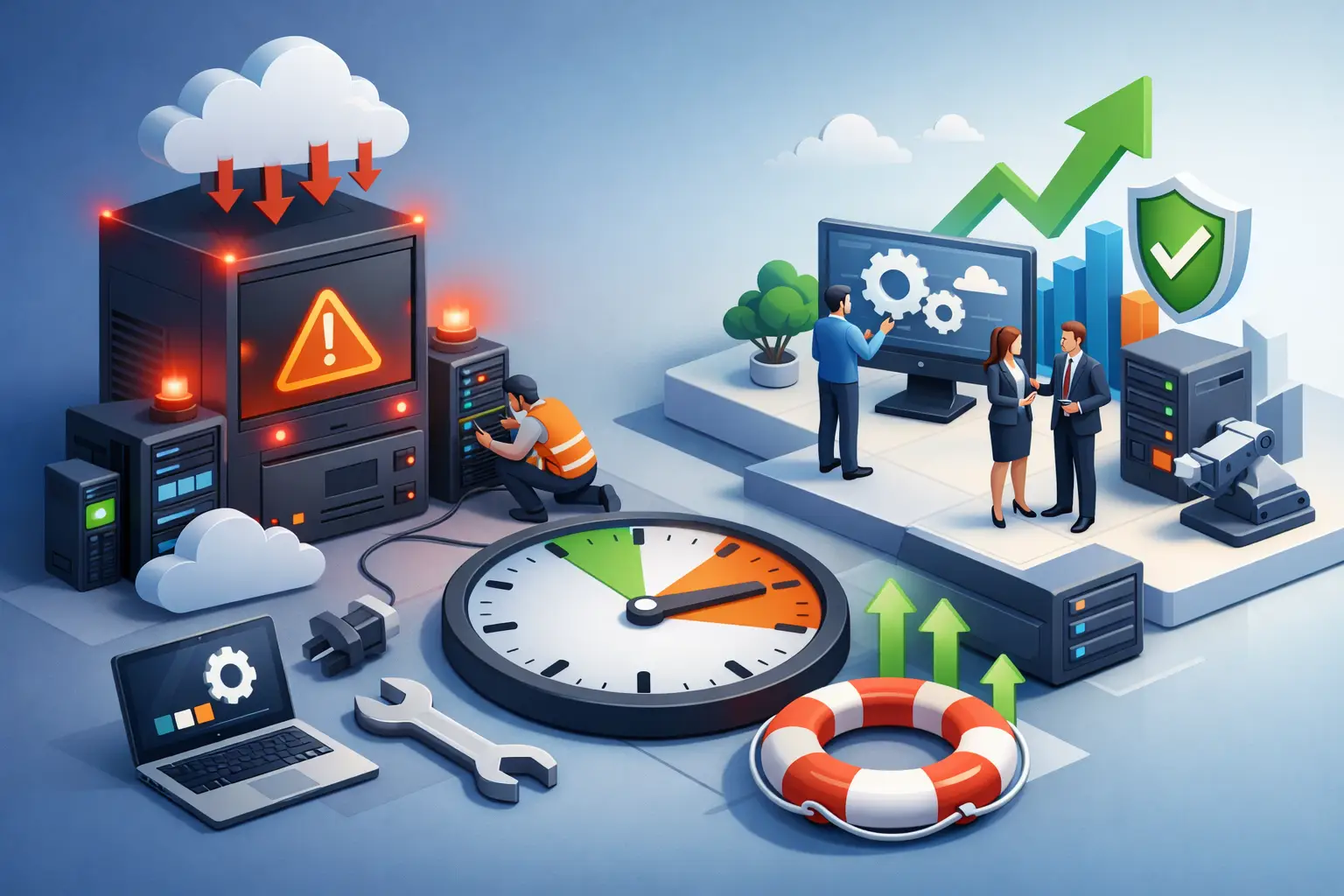
How to Reduce Business Downtime
A single hour of downtime can stall revenue, delay client work, lock employees out of systems, and create a ripple effect that lasts far longer than the outage itself. For small and mid-sized companies, learning how to reduce business downtime is not just an IT issue. It is an operational priority that affects service delivery, cash flow, reputation, and risk.
The hard part is that downtime rarely comes from one dramatic event alone. More often, it builds from smaller gaps: aging hardware, weak monitoring, poor documentation, missed patches, single points of failure, or a security incident that spreads faster than anyone expected. The businesses that recover fastest are usually the ones that planned before anything went wrong.
What actually causes downtime
Many leaders think of downtime as a server failure or internet outage. Those events matter, but they are only part of the picture. Downtime can start with a phishing email, an expired firewall license, a failed Microsoft 365 sync, a storage device nearing capacity, or an employee who cannot access a critical application because permissions were never documented properly.
That is why reducing downtime starts with visibility. If your organization does not know which systems are business-critical, who owns them, how they connect, and what happens when one fails, response becomes guesswork. Guesswork is expensive.
There is also a trade-off here. Some businesses overinvest in tools without fixing process. Others rely on staff heroics and tribal knowledge instead of disciplined systems. Neither approach holds up under pressure. The goal is not more technology for its own sake. The goal is dependable operations.
How to reduce business downtime with a prevention-first approach
The most effective way to reduce downtime is to prevent avoidable incidents before they interrupt the business. That sounds obvious, but many companies still operate in a break-fix mode, where support begins after users are already affected.
A prevention-first approach looks different. Systems are monitored continuously. Patches are applied on schedule. Endpoints, servers, network devices, and cloud platforms are managed as part of a defined operating model, not handled ad hoc when time allows. Security alerts are reviewed before they become outages. Backup jobs are checked, not just assumed to be working.
This is where mature IT management and cybersecurity need to work together. If your infrastructure team is focused only on uptime and your security team is focused only on threats, critical gaps can form between them. A ransomware event, for example, is both a security issue and a downtime event. The same is true for account compromise, misconfigured cloud access, or an unpatched firewall. Prevention works best when reliability and security are managed as one business continuity strategy.
Start with your critical systems, not your full environment
When companies try to improve resilience, they often begin too broadly. A better starting point is identifying the systems that the business cannot function without for even a few hours.
For a law firm, that may be document management, email, and secure file access. For a manufacturer, it may be line-of-business software, ERP, internet connectivity, and plant-floor devices. For a medical practice, downtime may affect scheduling, records access, billing, and compliance exposure all at once.
Once those priorities are clear, you can define realistic recovery expectations. Not every system needs the same level of redundancy, backup frequency, or support coverage. A business-critical file server should be treated differently than a low-impact internal tool. Matching protection levels to business impact is how you control cost without accepting unnecessary risk.
Build out the layers that keep outages small
Reducing downtime is rarely about one fix. It comes from layers that limit the blast radius when something fails.
Reliable endpoint and server management is one layer. If devices are patched, encrypted, monitored, and replaced on a planned lifecycle, failures are less frequent and easier to contain. Secure networking is another. Redundant internet, properly configured firewalls, segmented networks, and monitored switches can keep one issue from taking down the entire office.
Identity security matters just as much. Multi-factor authentication, conditional access, role-based permissions, and offboarding controls can stop account compromise from becoming a broader operational shutdown. For businesses heavily dependent on Microsoft 365 and cloud platforms, these controls are no longer optional. They are part of uptime.
Then there is backup and disaster recovery. Backups only reduce downtime if they are recent, recoverable, protected from tampering, and aligned to how the business actually operates. A nightly backup may be fine for one company and unacceptable for another. If your team would lose a full day of transactions, client notes, or production data, your recovery point is too far apart.
Why monitoring and response speed matter
Even well-managed environments still experience incidents. Hardware fails. Internet providers have outages. Users make mistakes. A vendor issue can affect your applications with no warning. The difference between a disruption and a crisis is often how quickly your team knows about the problem and how clearly they can respond.
That is why 24/7 monitoring has real business value. It shortens the time between failure and action. It can catch warning signs before employees open a flood of support tickets. It also supports cleaner escalation. When alerts, logs, documentation, and system context are all available, technicians spend less time diagnosing and more time resolving.
For security-related downtime, response speed becomes even more important. A phishing attack or suspicious login event can turn into widespread business interruption if it is not investigated quickly. Managed detection and response, security operations monitoring, and defined incident response procedures help contain issues before they spread across users, devices, and data.
Documentation is a downtime control
Documentation is not glamorous, but it is one of the most practical ways to reduce downtime. When key contacts, vendor details, network diagrams, asset inventories, recovery procedures, and access credentials are documented properly, teams make better decisions under stress.
Without that foundation, every outage takes longer. Staff waste time figuring out who owns what, where systems are hosted, which password vault has the right credentials, or whether a vendor change was ever recorded. That delay compounds quickly, especially in smaller organizations where one or two people carry too much institutional knowledge.
This is one area where growing businesses often struggle. They add locations, cloud tools, and employees faster than they improve process. The result is complexity without control. Good documentation turns growth into something manageable.
Testing matters more than intention
Many businesses believe they are prepared because they have backups, cyber insurance, or a disaster recovery plan on paper. But plans that are never tested tend to break at the worst possible moment.
If you want a practical answer to how to reduce business downtime, test the controls that matter most. Restore files from backup. Walk through an internet outage scenario. Confirm key staff can work remotely if the office is unavailable. Verify that emergency contacts, escalation paths, and security procedures are current.
Testing often reveals uncomfortable truths. Maybe the backup takes too long to restore. Maybe the failover process depends on one unavailable employee. Maybe a critical SaaS platform has weaker recovery options than expected. That is exactly the point. Finding those gaps during a test is far cheaper than finding them during a live incident.
The leadership question behind downtime
Most recurring downtime problems are not purely technical. They are leadership and planning issues. The business has outgrown its systems, but no one has updated the roadmap. Security was treated as a separate project instead of an operating standard. Internal IT is overloaded, or external support is too reactive to provide strategic oversight.
That is why many small and mid-sized organizations benefit from a partner that can manage both day-to-day operations and long-term risk. Sigma Networks works with businesses that need accountable IT leadership, stronger security, and clearer continuity planning without building a full enterprise IT department internally. The right partner should not just fix outages. They should help reduce the conditions that cause them.
There is no way to eliminate every interruption. Power fails, vendors go down, and people make mistakes. But you can make downtime rarer, shorter, and far less damaging by treating IT, security, backup, and planning as part of the same business function. The companies that handle disruption best are usually the ones that stopped waiting for failure to expose the gaps.
