

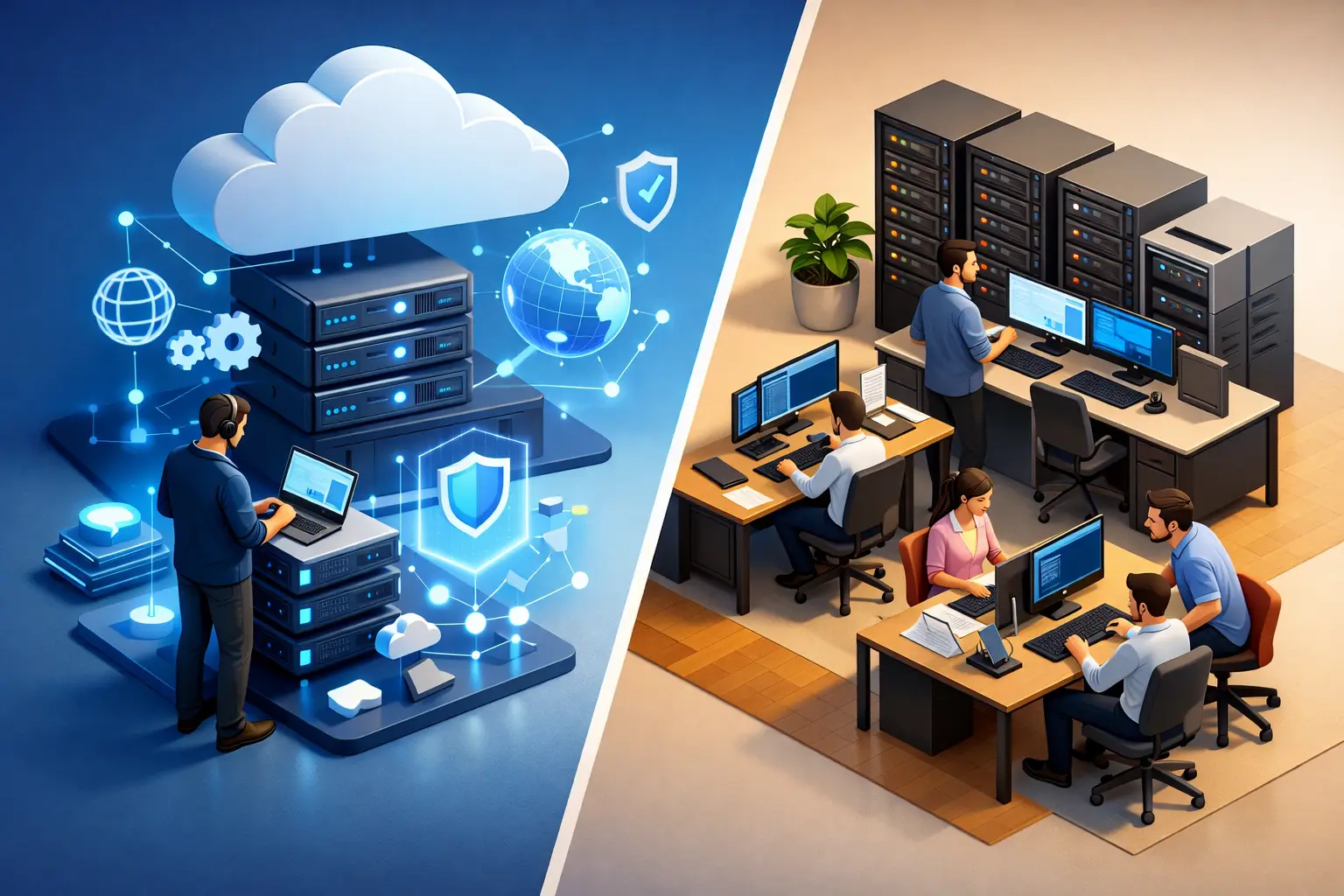
MSP vs Internal IT: Which Fits Best?
A lot of IT decisions look simple until the first outage, failed audit, or ransomware alert lands on a Tuesday morning. That is where the msp vs internal it question stops being theoretical and starts affecting revenue, client trust, and day-to-day operations.
For small and mid-sized businesses, this is rarely a pure technology choice. It is an operating model decision. You are deciding how your company will manage risk, support employees, control costs, and plan for growth. The right answer depends on your size, your compliance exposure, the complexity of your environment, and how much leadership you need from your technology team.
MSP vs internal IT: what is the real difference?
Internal IT means you hire employees to manage your systems, users, devices, vendors, and security controls. That can be one generalist, a small team, or a more mature department with specialists. The biggest advantage is direct alignment. Your internal staff knows your people, your workflows, and the history behind business decisions.
An MSP, or managed services provider, delivers outsourced IT management under an ongoing service model. Instead of relying on one or two in-house employees to cover everything, you gain access to a broader bench of engineers, support staff, processes, tools, and documentation. If the provider also delivers cybersecurity operations, monitoring, and incident response, you may be getting more than support. You are gaining a structured operating model for IT and security.
That distinction matters because most businesses do not struggle with isolated help desk tickets. They struggle with consistency, coverage, planning, and risk reduction.
Cost is not just salary vs contract
Many leaders start with cost, and that makes sense. On paper, internal IT can look straightforward. You pay salaries, benefits, training, software, and equipment. With an MSP, you pay a recurring monthly fee.
The comparison gets more complicated when you account for everything that is required to run IT well. A single internal hire may be able to reset passwords, manage onboarding, and troubleshoot printers, but that does not mean they can also handle cloud architecture, backup verification, compliance documentation, firewall management, endpoint protection, vendor coordination, strategic planning, and after-hours incident response.
That gap creates hidden costs. You either overpay for senior talent and still ask them to do basic support work, or you under-resource the role and accept risk. In many small and mid-sized organizations, the issue is not whether internal IT is cheaper. It is whether one person can realistically deliver enterprise-level coverage.
An MSP often spreads the cost of specialized tools and skilled labor across many clients, which makes stronger coverage more attainable. That said, if your company is large enough to fully utilize several internal specialists, internal IT may become more cost-effective over time.
Security changes the equation
A true msp vs internal it decision should include security from the start. Too many businesses treat cybersecurity as an add-on. It is not. It is part of daily IT operations.
An internal IT team can absolutely build a strong security program, but small teams usually face a bandwidth problem. They are already handling support requests, device issues, software problems, vendor escalations, and infrastructure maintenance. Security monitoring, patch validation, access reviews, incident response planning, and compliance documentation require time and discipline. Without those, security becomes reactive.
A well-run managed provider brings structure. That usually includes standardized patching, centralized monitoring, backup oversight, endpoint protections, access control policies, security awareness support, and documented escalation procedures. If the provider also operates as an MSSP, you can add 24/7 security operations, detection and response, and stronger visibility into threats.
This is especially relevant for healthcare, legal, financial, and professional services firms. If you handle sensitive client data, protected health information, financial records, or regulated workflows, the cost of weak security is much higher than the cost of support.
Control matters, but so does execution
One common argument for internal IT is control. That is valid. In-house staff are embedded in your culture, available for in-person interaction, and directly accountable through your own management structure. If your environment includes custom systems, highly specialized workflows, or heavy line-of-business application support, internal teams may respond more intuitively.
But control without process can create fragility. If documentation lives in one person’s head, if vendor relationships are informal, or if security decisions vary by urgency rather than policy, you do not really have control. You have dependency.
A mature MSP should improve operational control through documented procedures, service reporting, standardized tools, asset visibility, change management, and clear escalation paths. In other words, outsourced does not have to mean disconnected. In many cases, it means more disciplined.
The real question is not who sits in your office. It is who can consistently execute.
When internal IT makes the most sense
Internal IT is often the better fit when your company has enough scale and complexity to support dedicated roles. If you need constant onsite support, close coordination with specialized production systems, or internal ownership of highly customized environments, building an internal team can be the right move.
It also makes sense when technology is central to your business model and your leadership wants direct control over roadmaps, architecture, and staffing. A manufacturing firm with plant systems, an engineering firm with specialized design infrastructure, or a larger multi-location company may benefit from internal leadership that is deeply embedded in operations.
Still, internal IT works best when it is properly funded. One overstretched administrator is not the same thing as a strategic IT function.
When an MSP is the stronger choice
An MSP is usually the better option when your business needs broader expertise, predictable costs, and stronger coverage than a lean internal team can provide. This is common for organizations with 20 to 300 employees, especially those growing quickly or carrying compliance obligations.
The value is not just outsourced labor. It is access to a full operating model that includes support, monitoring, standards, security tooling, vendor management, documentation, and strategic guidance. That is often hard to build internally without significant investment.
For many businesses in North Texas and beyond, the practical issue is continuity. What happens when your sole IT manager is on vacation, leaves the company, or gets pulled into a major issue while employees are waiting for help? An MSP reduces key-person dependency and gives leadership more stability.
The hybrid model is often the best answer
The msp vs internal it debate can sound like an either-or choice, but many companies get the best result from combining both. Co-managed IT allows your internal team to retain ownership of business-specific priorities while the provider delivers depth, tooling, and coverage.
That might mean your internal IT manager handles day-to-day user relationships and application knowledge while the MSP supports cybersecurity, cloud management, after-hours response, backup oversight, and strategic projects. It can also mean using an external partner to fill skill gaps in areas like compliance, Microsoft 365 security, networking, or disaster recovery.
This model works well for growing companies that already have IT staff but do not want to keep hiring specialists for every new demand. It also helps internal leaders avoid burnout by shifting operational burden off their plate.
How to decide between MSP vs internal IT
Start with your risk profile, not your preferences. If downtime is expensive, if compliance matters, or if your clients expect strong data protection, your IT model must support consistency and accountability.
Next, look at coverage. Do you have enough qualified people to handle support, infrastructure, cloud, security, vendors, and planning without creating single points of failure? If not, internal IT may feel familiar but still leave the business exposed.
Then consider maturity. Are your systems documented? Are backups tested? Are security controls enforced consistently? Do you have clear lifecycle planning for hardware, software, and cloud services? The right provider should strengthen those fundamentals, not just answer tickets.
Finally, think about leadership. Many businesses do not only need technicians. They need guidance on budgeting, risk, compliance, and future-state planning. That is where a strategic partner creates far more value than a reactive support model.
For some companies, that partner is an internal IT leader. For others, it is a managed provider with the structure to deliver both day-to-day execution and long-term direction. Sigma Networks works with organizations in exactly that position, especially those that need dependable support and stronger security without building a large internal department.
The best IT model is the one that protects the business, supports growth, and holds up under pressure when something goes wrong.
